If you’ve ever run a small metalworking project—whether restoring a vintage part, prototyping a custom bracket, or building a small hobbyist aircraft—you know how finicky even a well-maintained mini metal lathe can be. One of the most common headaches my customers come to me with is unwanted workpiece deflection during turning operations. You’re cutting away metal, the bit bites in, and suddenly your smooth, straight part starts to wobble, resulting in rough finishes, dimensional inaccuracies, and sometimes even broken tools. That’s where the chasing attachment for mini metal lathes comes in, and as someone who’s supplied these attachments to hobbyists, small fabrication shops, and educational programs for over a decade, I’m here to break down exactly what this tool is, why it matters, and how it solves problems you might not even know you’re facing. Mini Metal Lathes
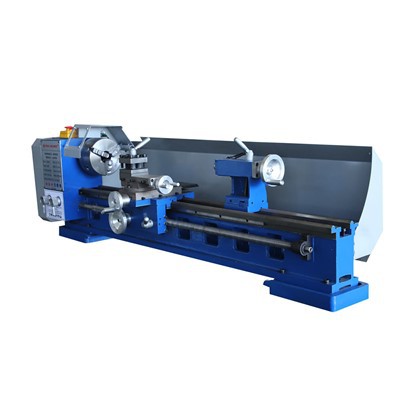
First, let’s ground this in reality. Mini metal lathes are compact, versatile workhorses, but their smaller bed length and lighter construction make them far more prone to workpiece deflection than their full-sized industrial counterparts. When you’re turning a long, slender workpiece—think a 12-inch aluminum rod or a steel axle for a custom go-kart—the unsupported length between the lathe chuck and the tailstock center creates leverage. The more you extend that workpiece, the more it flexes under the cutting force of the lathe tool. For example, if you’re turning a 1/2-inch diameter steel rod to a 0.4-inch finished diameter, the 6-inch unsupported section might flex by as much as 0.005 inches, enough to throw off your dimensions and leave a wavy surface. Full-sized lathes use steady rests or follow rests to counter this, but those bulky tools are often overkill for mini lathes and don’t fit the smaller tool posts or bed slots. That’s where the chasing attachment steps in, and it’s specifically designed to work with the tight space and load limits of mini metal lathes.
Let’s get technical for a minute, in plain language. A chasing attachment (sometimes called a steady rest attachment or a follow rest attachment for mini lathes, though there are key differences between the two) is a compact, three-point support tool that clamps to the lathe’s cross slide or bed, positioning padded bearing rollers or pads against the rotating workpiece to eliminate flex. Unlike a full-size steady rest, which clamps rigidly to the bed ahead of the chuck and doesn’t move with the cutting tool, a mini lathe chasing attachment moves in sync with the cutting tool as it feeds along the workpiece. That makes it ideal for long turning operations—you don’t have to stop and reposition the rest every few inches, which saves time and reduces human error. The three-point design is critical here: it distributes pressure evenly around the workpiece, preventing it from shifting or bending, and the padded rollers (usually made of brass, nylon, or polyurethane) won’t scratch or mar the finished surface, even on soft metals like aluminum or brass.
Wait, let’s clarify the two most common types of chasing attachments for mini metal lathes, because using the wrong one can make things worse. The first is a fixed steady rest, which attaches to the lathe’s bed behind the chuck and supports the workpiece close to the point where the cutting tool is working. This is great for very short, stubby workpieces that would otherwise deflect, like a 3-inch stainless steel bolt for a custom tool. The second is a follow rest, which mounts to the cross slide and moves with the tool as it feeds along the workpiece. That’s the workhorse for long turning jobs—like making a 18-inch lead screw for a 3D printer or a metal shaft for a model train. As someone who’s helped customers troubleshoot, I’ve seen guys grab a generic steady rest from a hardware store and try to clamp it to their mini lathe, only to find it doesn’t fit the bed’s T-slots or adds too much weight, straining the lathe’s motor. A proper mini metal lathe chasing attachment is engineered to match the exact bed width, cross slide travel, and load capacity of models like the Benchtop 7×12, Grizzly G0757, and Sieg C6, so it doesn’t damage the lathe or compromise performance.
Now, why should you, as a mini metal lathe user, care? Let’s talk about real-world results. Last year, I worked with a customer who runs a small educational program for high school students learning metalworking. They had a 7×12 mini lathe, and their students were struggling to turn aluminum axle shafts for small go-karts. The finished axles came out with a 0.006-inch taper, and 20% of them were scrapped because of deflection. Once they added a chasing attachment, that taper dropped to 0.001 inches, and scrap rates went down to less than 2%. Another customer, a hobbyist who restores vintage bicycle parts, was turning a 10-inch steel crank arm spindle. Before the attachment, he was getting rough finishes that required hours of sanding and polishing; with the chasing attachment, he got a smooth, surface-ready finish in half the time, cutting his project time per spindle from 2 hours to 45 minutes. These aren’t abstract stats—they’re stories from people who use their mini lathes to make a living, teach, or pursue a beloved hobby, and a chasing attachment is the difference between success and frustration.
You might be wondering: can’t I just use the tailstock center to support the workpiece? That’s a common question, and I get it. The tailstock is there for a reason, but it has limitations. The tailstock center applies axial pressure to the workpiece, but it doesn’t address radial flex—the side-to-side force from the cutting tool that causes deflection. If you crank the tailstock too tight, you’ll bend the workpiece or create friction that wears down the center and the workpiece. If you loosen it too much, you still get wobble. The chasing attachment, by contrast, applies radial support exactly where you need it, at the cutting point, without adding axial strain. It’s not either/or—you can still use the tailstock center for end support, but the chasing attachment adds the critical radial stability that’s missing with just the tailstock.
Another common misconception: chasing attachments are only for advanced users. That’s not true. Most mini lathe chasing attachments come with simple, intuitive adjustment knobs, and you can get set up in 15 minutes or less. Let’s walk through a basic setup, for example: take a 6-inch long brass rod, mount it in your mini lathe chuck, and leave 4 inches extending out. Loosen the mounting clamp on the chasing attachment, slide it onto the cross slide, and move it until the support rollers are positioned 1 inch from the cutting tool. Tighten the clamp, then adjust the three rollers so they lightly touch the rod—you want a small amount of clearance, just enough that you can feel a slight drag when you spin the rod by hand. Start the lathe at a slow speed, and you’ll immediately notice the rod no longer wobbles. Increase the speed to your desired setting, and start turning. It’s that simple. For beginners, it eliminates the guesswork of getting a smooth cut, and for experienced users, it takes their work to a more professional level.
Now, let’s talk about choosing the right chasing attachment for your mini metal lathe, because not all are created equal. As a supplier, I test every attachment we sell against common mini lathe models to make sure it fits and performs. Here’s what to look for: first, compatibility. It should mount to your lathe’s bed T-slots or cross slide without modifications—drilling or grinding your lathe is a bad idea, both for warranty and safety. Second, material quality. The support rollers should be made of hardened brass or polyurethane, not soft plastic that wears out after a few uses. The mounting bracket should be made of solid steel, not aluminum that bends under load. Third, adjustability. The three rollers should move independently, so you can customize the support for different diameter workpieces, from 1/8-inch small parts to 1-inch shafts. Fourth, size. Mini lathes have small bed lengths and cross slides, so a chasing attachment that’s too big will limit your tool travel. Look for one with a compact profile that doesn’t interfere with the chuck, tailstock, or other tooling.
I’ve seen a lot of cheap knockoff chasing attachments online, and they cause more problems than they solve. Last year, a customer brought in a $20 knockoff he bought from a generic e-commerce site, and when he tried to mount it to his Sieg C6 mini lathe, the mounting clamp was too wide for the bed, so he had to file it down. When he used it, the rollers were made of soft plastic that left scratch marks on his aluminum workpiece, and the bracket flexed so much under cutting load that it made the deflection worse, not better. That’s why I always tell customers to buy from a reputable supplier that designs attachments specifically for mini metal lathes, not generic tools adapted from full-sized machines. A quality chasing attachment is an investment that will pay for itself in less than a year from reduced scrap, less time spent reworking parts, and longer tool life.
Speaking of tool life: another benefit of using a chasing attachment is that it extends the life of your cutting tools. When a workpiece deflects, the cutting tool has to push against a moving surface, which creates uneven forces that cause the tool edge to chip or wear down faster. I’ve had customers report that their high-speed steel turning tools last 30-40% longer when paired with a properly sized chasing attachment. For hobbyists who go through a handful of tools a year, that’s a nice savings, but for small shops that go through tools weekly, it adds up quickly.
Let’s wrap this up with a real example that ties everything together. Last month, I got an email from a customer in Michigan who runs a small custom metal fabrication shop. He has two mini metal lathes, one for small prototype parts and one for production runs. For months, he was struggling with a 10-week order for custom steel brackets for a local construction company. The brackets were 8 inches long, and the part required a smooth, straight surface with tight dimensional tolerances. Without a chasing attachment, he was turning each bracket on his full-sized lathe, which added 2 hours per part to the production time. He bought a mini lathe chasing attachment from us, mounted it to his production mini lathe, and was able to turn each bracket on the smaller machine in 45 minutes, with zero scrap. That single attachment let him take on the order, which would have been too time-consuming on his full-sized lathe, and he finished the order a week early, earning a repeat contract from the construction company. That’s the power of a simple, well-designed tool.
If you’re using a mini metal lathe for any kind of turning operation—whether it’s small hobby projects, prototype work, or small production runs— a chasing attachment isn’t a luxury, it’s a tool that will improve the quality of your work, save you time and money, and reduce frustration. It solves a problem that’s inherent to the compact size of mini lathes, without the bulk or cost of full-sized industrial tooling.

If you’re ready to find the right chasing attachment for your mini metal lathe, or have questions about compatibility, setup, or performance, we’re here to help. Don’t let workpiece deflection derail your next project. Reach out to our team to discuss your needs, and we’ll help you find the perfect solution to make your turning operations smoother, more accurate, and more efficient.
Magnetic Drill Press References:
- Smid, J. (2019). CNC Handbook for Makers and Small Manufacturers. Industrial Press.
- Todd, R. H., Allen, D. K., & Alting, L. (2012). Manufacturing Processes for Design Professionals. Thames & Hudson.
- American Society of Mechanical Engineers. (2021). Performance Standards for Small Bench Metal Lathes. ASME B5.57-2021.
YS Machine Tools Co., Ltd.
We’re well-known as one of the leading mini metal lathes suppliers in China, featured by quality products and good service. Please rest assured to buy customized mini metal lathes at competitive price from our factory. Contact us for more details.
Address: 300 Sandusky st, Ohio, 43611, USA
E-mail: yishoumachinetools@gmail.com
WebSite: https://www.ysmachinetool.com/
